
Why on earth would you ever eat fucking cashews?!?!, you ask incredulously.
Good question!
After all, behind chestnuts, cashews contain the highest carbohydrate content among nuts and compared to others, they only have a moderate amount of fiber.
Cashews = 🤮
But here’s the thing…
While cashews do have the aforementioned knocks against them that might make them less appealing to eat than other varieties of nuts, what they have in their favor is significant amounts of protein and monounsaturated fat, both of which promote weight management in their own respective ways, such as by having satiating and filling effects on appetite that help curb food intake, for example.
Aside from cashews containing monounsaturated fat and protein that each contribute to doing a better job of losing and maintaining weight, cashews are also exceptionally rich in copper. Now, what’s so special about that mineral is that research suggests it plays a key role in lipolysis, which is the process of breaking down fat cells for the body’s use as energy. Essentially, having adequate levels of copper helps make the body more efficient at burning fat. With that being the case, cashews are a great snack choice when watching your figure because more than 65 percent of the recommended daily requirement of copper can be supplied by about 18 cashews.1If you don’t want or like cashews, however, other copper-rich foods include beef liver, lobster, oysters, shiitake mushrooms, sunflower seeds, firm tofu, dark chocolate, and Garbanzo beans. Regardless of the copper choice, it should be part of a balanced diet rather than making up the entirety of it, as too much copper can be harmful.
Yeah, I know, cashews sound mighty, mighty tasty right about now!

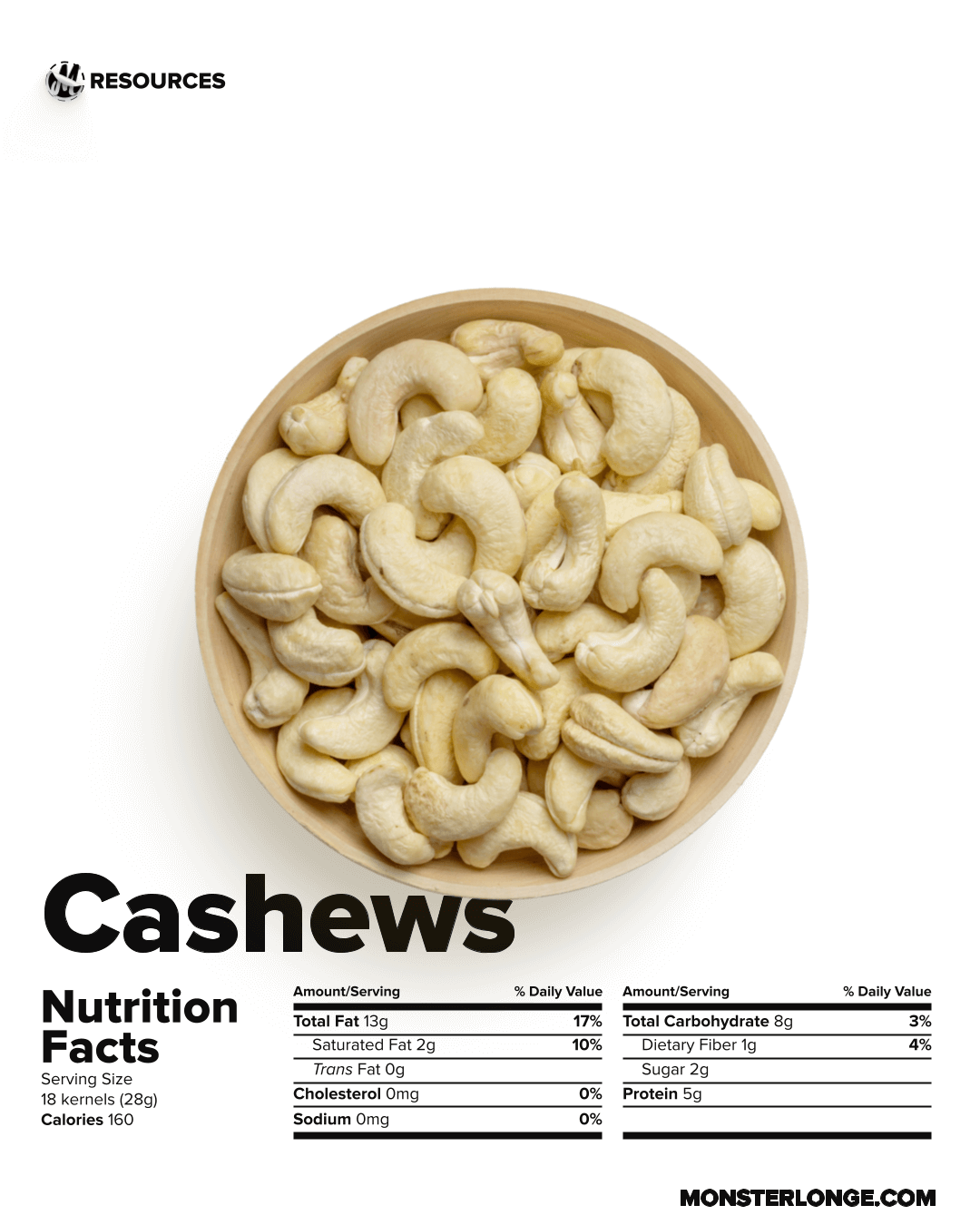
Cashew Nutrition Facts
Serving Size 18 kernels (28g)
• Calories: 160
• Total Fat: 13g
• Cholesterol: 0mg
• Sodium: 0mg
• Total Carbohydrate: 8g
• Dietary Fiber: 1g
• Sugar: 2g
• Protein: 5g
NOTE: Like all nuts, cashews provide fewer calories than the number of calories listed on nutrition labels because the body can’t break down the cell walls to access all of the protein and fat. As a result, some of those calorie-rich nutrients don’t get exposed to digestive enzymes. In the case of cashews, it’s estimated that only 84 percent of the calories are absorbed by the body for energy, which means that the available energy content of cashews is 16 percent lower than what you’ll find printed on a food label.
Glossary: calories, diet, dietary fat, fat, food

- Just The Tip #4441 - May 5, 2026
- Just The Tip #400 - May 4, 2026
- Just The Tip #3017 - April 30, 2026