
How To Build Chest Muscles
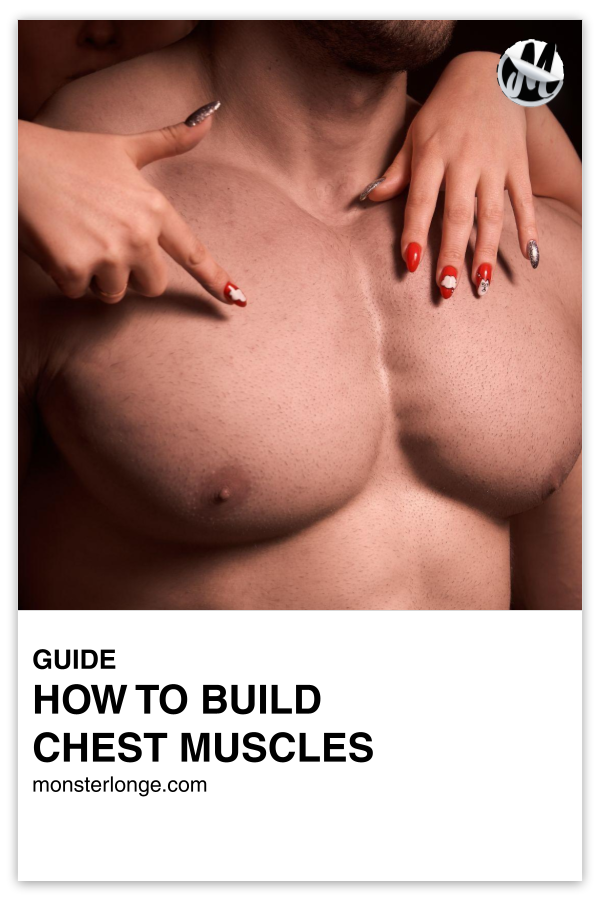
Are you a dude? A dude with whom a prepubescent girl has more chest development than?
Well, I’m here to tell you that a small chest doesn’t make you any less of a woman, buddy. These are progressive times we’re living in. Self-love and body acceptance, motherfucker!
Buuuuuuttttt if you’re not quite ready to take your seat at the head of the Itty Bitty Titty Committee, this handy-dandy guide will show you how to build chest muscles.
Now, let’s go ahead and slap some boobage on ya!

The chest is a muscle group consisting of two muscles that work together to make the chest function. Named according to their size, these muscles are the pectoralis major and pectoralis minor. Understanding their anatomy and the roles they play in movement are beneficial for proper exercise selection.
The pectoralis major is located on the front of the chest wall and is comprised of three parts with fibers that are oriented in different directions. The clavicular head originates from the medial half of the clavicle, or collarbone. This is known as the upper chest and its fibers travel downward and laterally toward the upper arm. The sternal head originates from the sternum and the first 7 cartilages of true ribs. Its fibers run horizontally across the chest and is why it’s categorized as the middle, or inner, chest. Lastly, the abdominal head originates from the aponeurosis of the external oblique muscle. This segment of the pectoralis major is known as the lower chest and its fibers travel upward and laterally from the center of the chest. Together, the heads converge and insert on the intertubercular groove of the humerus and are involved in flexing, internally rotating, and adducting the arm at the shoulder joint.
All of the heads of the pectoralis major contract to move the arms according to the muscle’s function but to varying degrees. That means that during a chest exercise, it’s not possible to completely isolate a section of the chest from another. With that said, however, it is possible to emphasize the development of an area. That can be done primarily with pressing and fly motions through different arm positions and body angles that bias the fibers. These exercises should be known to better sculpt the chest according to your needs and wants.
UPPER CHEST
The easiest way to target the upper chest is to perform chest movements on an incline bench. Examples include the incline bench press, incline dumbbell bench press, incline dumbbell flyes, and incline cable flyes.1According to EMG data, a 30-degree angle elicits the most activation of the region. Individual differences can arise, however, so it may be best to experiment with the angle to find one where you feel a given exercise in the upper chest most. If doing so, just be aware that a 45-degree angle and higher leads to greater engagement of the shoulders. Aside from positioning the body at an angle with a bench, as well as by propping the feet on an elevated surface, such as with decline push-ups, the upper chest can also be worked by placing the arms in a position that stretches the pectoralis major and transfers stress onto the clavicular head. Examples of exercises fitting that bill include the wide-grip bench press and wide-arm push-ups. The last kind of exercises that target the upper chest are those where the arms are at the side and away from the body before moving up and across in a diagonal path. Examples include low-to-high cable flyes and low-to-high cable crossovers.
MIDDLE CHEST
Chest exercises that are performed with a pressing motion at a flat angle target the middle chest. Examples include the bench press, dumbbell bench press, push-ups, and seated cable chest press. The middle chest also receives a lot of the stimulus with exercises that involve bringing the arms in toward the body horizontally. Examples include dumbbell flyes, cable flyes, cable crossovers, and the pec deck machine.
LOWER CHEST
Exercises for the chest that place the arms below the level of the chest recruit the lower region of the pectoralis major more than other regions. Examples include the decline bench press, decline dumbbell bench press, decline dumbbell flyes, decline cable flyes, incline push-ups, and dips performed with a forward lean. Other exercises include high-to-low cable flyes and high-to-low cable crossovers, which bring the arms down and across the body.
The pectoralis major is the largest muscle in the chest and is commonly what people are referring to when they talk about the “pecs”. Given its large size, it’s what’s responsible for the overall shape and appearance of the area. That, however, isn’t the only muscle that should be worked for a bigger chest. There’s also the pectoralis minor that lies beneath the pectoralis major.
Originating from the third, fourth, and fifth ribs and inserting into the coracoid process of the scapula, the pectoralis minor functions to stabilize the scapula and move the shoulder down and forward, as well as to rotate it inward. Much smaller in stature than the pectoralis major, development of the pectoralis minor may cause it to push against the larger muscle and thus contribute to the appearance of a fuller chest in the way that growth of the brachialis that’s buried underneath the biceps brachii can enhance the width and thickness of the upper arm. But even if that’s not the case, working the pec minor may have indirect effects on the size of the chest by increasing the effectiveness of exercises and reducing the risk of injury to use heavier and heavier weight, as the muscle helps with scapular movement and shoulder stability.
Just as it’s not possible to isolate the regions of the pectoralis major, it’s also not possible to work the pectoralis minor alone. The pectoralis major is involved with everything the smaller muscle does. Nevertheless, there are exercises that activate it more than others. These include incline dumbbell flyes, cable flyes, high-to-low cable crossovers, close-grip push-ups, deficit push-ups, LaLanne push-ups, limited-range dumbbell pullovers, and straight-arm dips.
As detailed, the pectoralis major and minor are the muscles of the chest. However, while both play a role in its function, it’s the pectoralis major that’s integral to the appearance. Its upper, middle, and lower regions should all be trained for balanced development of a more prominent and muscular chest but what you choose to focus on will ultimately depend on your particular needs and desires.
Regardless, any chest routine should include a bilateral pressing movement with heavy weight to overload the chest and a unilateral pressing movement to get a greater contraction of the chest from being able to draw the arms more inward because they work independently and aren’t locked into place at a distance on the ground, such as is the case with push-ups, or by the handle of a piece of equipment, as occurs with a barbell. Also in the mix should be an adduction movement to work the chest through it’s real range of motion, which isn’t pushing but is instead bringing the arms across the body. Including such an exercise in your training will not only work the chest without as much assistance from muscles that help during pressing motions, such as the triceps and anterior deltoids, but engaging in the adduction movement pattern with light weight and high reps will also help drive blood into the chest, which can have the effect of increasing the metabolic stress on the muscle and prompt another pathway to muscle growth. All exercises involving these movements should be performed with a deep stretch at the bottom of the lift, which helps to stimulate growth by placing greater tension on the target chest muscle.
Apart from picking the right exercises and performing 12-20 total sets, there’s nothing extra to chest training. Everything else that applies to training any other muscle group applies. That means that for any exercise you perform, it should be executed with proper lifting form to reduce the risk of injury and that of muscles other than the target chest muscle receiving the benefit. Further, chest exercises in your routine have to increase in difficulty in accordance with progressive overload to continue giving the chest muscles a stimulus to adapt to. So long as those principles are followed and your nutrition and recovery protocols are in order, your chest will grow in response to training it.
Glossary: abs, arms, barbell, bench, chest, dumbbell, exercise, exercise equipment, lifting-form, muscle, muscle group, nutrition, reps, routine
, training

- Just The Tip #4441 - May 5, 2026
- Just The Tip #400 - May 4, 2026
- Just The Tip #3017 - April 30, 2026