
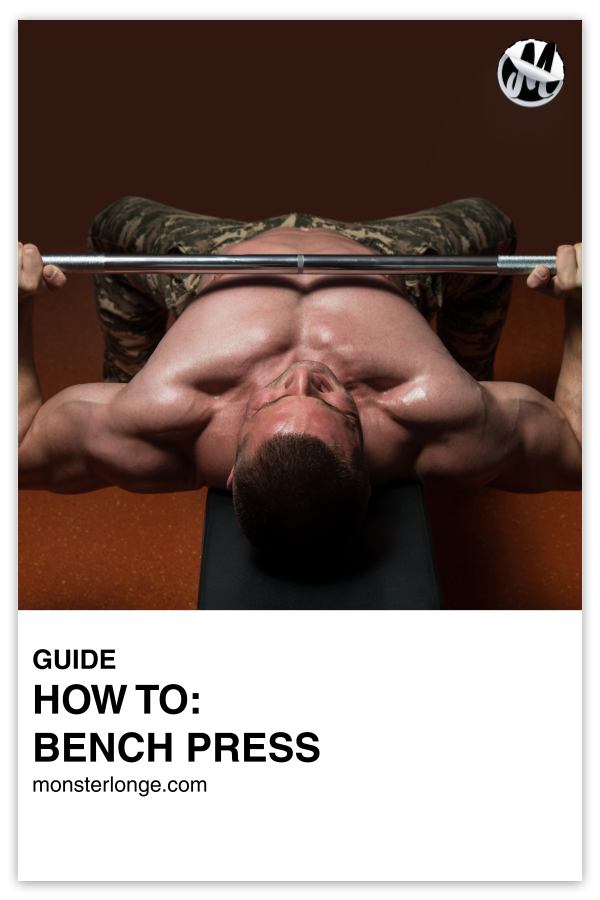
How To Bench Press Properly
The bench press primarily works the pectoralis major, which is the largest muscle of the chest, as well as the anterior deltoids of the shoulders and the triceps, which are located in the back of the upper arm.
As for the execution, what’s there to say really?
All you do is lie on a flat weight training bench under a barbell and move the weight up and down a few times.
Simple!
However, while true that the bench press is as basic as it was just described, it’s not so easy to perform because it’s one of the most commonly butchered exercises in the gym, which leads to poor results, if not immediate or eventual injury.
So what’s someone supposed to do for a stronger and bigger chest, of which the bench press is one of the best exercises for?
Well, it might be a good idea to start with the following instructions that detail how to bench press properly.
That’s just a guess, though!
INSTRUCTIONS
1). Lie down on a flat bench so your eyes line up directly underneath the barbell.1Here, the barbell shouldn’t be so low that you have to perform a partial rep to unrack the weight. Neither should the bar be so high that your shoulders come off the bench when you grab the bar and lift it from the rack, as that can compromise the ability to keep the scapula in the proper position outlined below.
2). Spread your legs so they’re about shoulder-width apart and plant your feet flat on the ground.2Here, your knees can either form a right angle or you can draw your legs back toward your body but not so far that your feet are excessively tucked behind your knees.3NOTE: Once planted, your feet should remain stationary throughout the lift. If you find them moving, a helpful cue might be to imagine that your feet are in cement.4NOTE: If you’re too short to plant your feet on the ground because the bench is too high, use weight plates to create an elevated platform for you to rest your feet on.
3). Arch your back slightly.
4). Grab the barbell with a shoulder-width grip, or slightly narrower, and wrap your thumbs around the bar.5Grab the barbell as far down your palm as possible instead of high in your hand or in your fingers. This will help keep the wrists straight and prevent them from bending backwards, as will thinking about rolling your knuckles towards the ceiling.6NOTE: Don’t use a suicide, or thumbless, grip when bench pressing because it not only reduces activation of the pecs but it also impacts grip strength and increases the risk of serious injury from the barbell slipping out of your hands and falling onto your chest or neck.
5). Retract and depress your scapula and push your upper back into the bench.7To retract your scapula, imagine that you’re trying to crush a grape between your shoulder blades. To depress them, pull your shoulder blades down toward your feet like you’re tucking them into the back pockets of your jeans. Maintain this position throughout the entire lift.
6). Breathe in, brace your core, and squeeze the barbell as tightly as possible as you lift it off the rack.
7). With your elbows tucked at about 45° instead of flared out directly to your sides at 90°, bend your elbows and lower the barbell toward your chest.
8). Come to a complete stop for at least 1 second when the bar touches the middle of your chest then breathe out as you straighten your elbows and return to the starting position, which should be done by trying to push yourself away from the bar instead of pushing it off you.8A helpful cue for this is to imagine that you’re pushing your body through the bench. Also, drive your feet into the ground by pressing down and forward instead of straight down.
9). Raise the barbell until your elbows are just short of locking out entirely then squeeze your chest.
10). Pause for 1-2 seconds and perform the next rep.
NOTE (1): If lifting heavy, it’s always best to bench press with a spotter present to avoid the risk of death or serious injury from getting trapped underneath the barbell if you’re unable to move the weight after lowering it. If you have to bench press by yourself, make sure to do so in a power rack with the safety arms or pins properly set up, which should be low enough for you to touch the bar to your chest but high enough to rest the barbell on and shimmy your body out from underneath if the need arises. When benching alone, it also helps to lift without collars or clips on the ends of the barbell, as not securing the weight allows you to tilt one end of the bar to slide the weight off the opposite end.
NOTE (2): Lifting the hips or glutes off the bench can reduce the engagement of the intended muscles and place undue stress on the lower back by causing it to overarch. If this happens, then it may be beneficial to look at your foot placement and try a wider stance or move your feet further away from the bench; stabilize the pelvis more by actively squeezing the glutes throughout the lift and making sure to push your knees out; or work on your leg drive technique so you’re not pushing your feet straight down into the ground but are pushing through your big toe and driving your feet forward into the ground like you were trying to perform a leg extension.
NOTE (3): It’s a popular belief that bench press with the legs elevated in the air causes greater chest activation. A study published in PLoS One seems to support that theory, as electromyographic activity shows significantly greater activation of the pectoralis major when the legs are suspended compared to on the ground.9In the study, the hips were flexed and the knees were bent 90°. Be that as it may be that the chest is recruited more when the legs are lifted, it’s not advised to bench press that way for strength or hypertrophy purposes because muscle activation isn’t the only consideration for getting bigger and stronger. Instead, there are also factors like mechanical tension and the creation of muscle damage. Toward that end, bench pressing without your feet on the ground increases activation of the core muscles to stabilize your body while simultaneously reducing overall stability, which in turn affects the ability to lift heavy enough weight to place a demand on the chest to trigger the cellular processes that prompt a training adaptation in size and strength. Another problem is that as a consequence of your legs being raised, you’re then unable to arch your back on the bench and retract your scapula to take the stress off your shoulders. This and the mentioned lack of stability both increase the risk of injury, especially when working with big loads. For these reasons, it’s better to keep your feet planted on the ground so you have a stable base to support yourself and generate leg drive to assist with the lifting of heavy weight. The only exception when it might be beneficial to bench press with your feet off the ground is if you have a history of back pain, as having the feet suspended helps keep your back flat instead of it being arched like in the conventional setup.

For a workout routine that possibly includes the bench press, as well as other exercises geared specifically to your goals, training experience, injury history, and available equipment, then find out more HERE
Glossary: arms, barbell, bench, chest, exercise, goal, glutes, gym, hypertrophy, muscle, reps, results, routine, spotting, train, workout

- Just The Tip #4441 - May 5, 2026
- Just The Tip #400 - May 4, 2026
- Just The Tip #3017 - April 30, 2026