
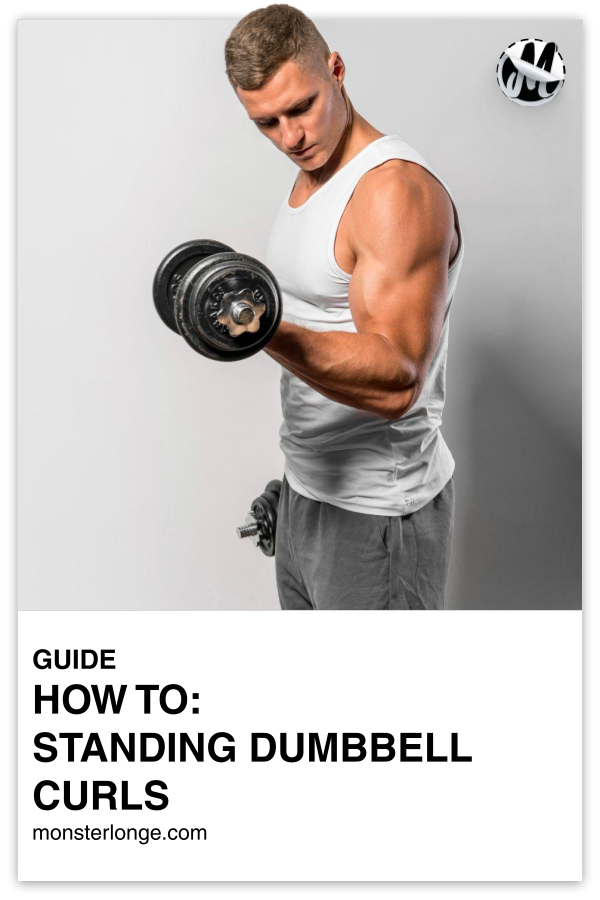
How To: Standing Dumbbell Curls
The difference between standing dumbbell curls and seated dumbbell curls?
Well, one is performed standing and the other is performed seated.
DUH!!!
But seriously, both standing dumbbell curls and seated dumbbell curls isolate the biceps but because the exercise is performed on one’s feet, the standing variation involves more isometric contraction of the abs to stabilize the body. Activation of the abdominal muscles to the same degree isn’t necessary when doing seated dumbbell curls. That’s one difference between the two. Another is that while it’s certainly possible to cheat while performing seated dumbbell curls, it’s harder to do so by generating momentum with your legs and back to move the weight. This in turn forces the biceps to do more of the work and makes seated dumbbell curls better for isolation purposes. Conversely, standing dumbbell curls provide for easier use of body English, which may allow for greater overload of the biceps with the ability to lift heavier weight or extend sets to complete failure once you can no longer perform reps with proper form.
INSTRUCTIONS
1). Grab a pair of dumbbells and stand with your legs spread about shoulder-width apart and a soft bend in your knees. With your back straight, chest up, and shoulders back, your arms should be fully extended along the side of your body with your palms in neutral, or facing each other.
2). Brace your core, pin your elbows to the side of your body, and breathe out as you raise the dumbbells upwards by twisting your wrists as you simultaneously bend the elbows until your forearms are vertical and your palms are facing your chest.
3). At the top, twist the wrist of each arm so your pinkies are turning in the direction of your thumb and then squeeze the biceps for 1-2 seconds before lowering your arms to the starting position so your hand is once again in neutral.
4). Pause for 1-2 seconds then repeat.
NOTE (1): The only movement throughout the lift should take place at the elbow joint itself. If the elbows are not tucked and stationary but are instead allowed to move away from the body as you curl the dumbbells, then you’re using too much weight. The same goes for any action occurring in your shoulders or back! Except for your elbows moving at the joint, your body should remain completely still throughout the exercise.
NOTE (2): Once you become too fatigued to perform the exercise with both arms at the same, you may switch to performing the remaining reps and/or sets by alternating between arms for each rep, which means you’ll do one rep with the left arm and then another with the right arm, for example.

For a workout routine that possibly includes standing dumbbell curls, as well as other exercises geared specifically to your goals, training experience, injury history, and available equipment, then find out more HERE
Glossary: abdominals, abs, arms, barbell, biceps, cheat, chest, dumbbell, exercise, exercise equipment, goal, lifting form, muscle, reps, routine, train, workout

- Just The Tip #4441 - May 5, 2026
- Just The Tip #400 - May 4, 2026
- Just The Tip #3017 - April 30, 2026