
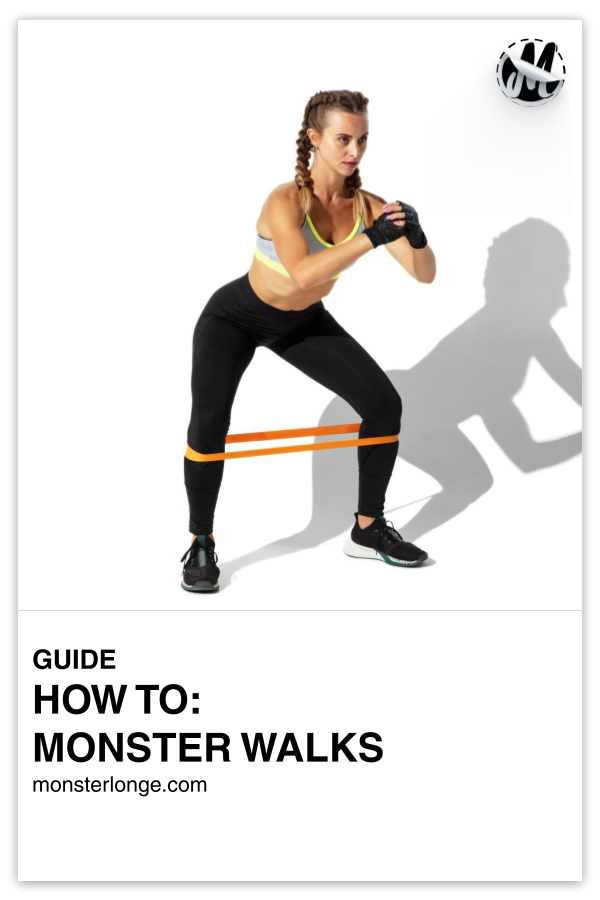
How To: Monster Walks
When people think of a monster walking about, they most likely conjure up images of Godzilla making its way through a densely populated city and wreaking havoc all about. That’s a terrifying sight.
Although named “monster walks”, the exercise doesn’t evoke the same imagery. The wide, awkward gait that’s used to perform the movement is anything but one that inspires terror. Instead of people running for their lives every time they see you coming by as you perform the monster walk, they’ll probably bust out laughing at you because of how silly it looks.
…
That is, until a couple of months go by and they notice that you have bigger and firmer glutes from adding the exercise as a complement to your squats, lunges, deadlifts, hip thrusts, and other conventional exercises performed with barbells, dumbbells, machines, cables, and other equipment that allow for greater and greater overload to challenge the body and elicit the effects of hypertrophy.1Monster walks, also known as band walks, aren’t only beneficial to the glutes and hips. They also work the quads, hamstrings, and core to a lesser degree.
INSTRUCTIONS
1). Stand with your feet hip-width apart and a band slightly above or below your knees.2NOTE: The band doesn’t have to be around your knees. You can also place it further up your thighs or around your ankles. Just keep in mind that the location of the band is correlated with the difficulty of the exercise and amount of glute activation that’s elicited. So if you want to make the exercise easier, then place the band around the thighs closer to the lever, which are the hips. The only drawback is that it won’t be as effective for the target muscles. If you want to perform the exercise with the most engagement of the glutes, then place the band the furthest away from the hips, which is around the ankles. The potential drawback with that placement is the increased challenge of performing the exercise. Having the band around the knees is the happy medium between what those two locations provide.
2). Press your hips back, bend your knees to lower into a quarter squat, and push your knees against the band to create tension.
3). While maintaining the quarter-squat position and holding your hands on your hips or clasped with your elbows bent in front of your body, brace your core, pick up your foot, and move your leg toward the midline of your body and then forward and out to the side against the band.3That means you should take wide diagonal steps so if, for example, you’re using your right leg, then it should simultaneously travel ahead and to the right.
4). Plant your foot on the ground in front of you and slightly to the outside and force both knees out against the band.
5). Without rising up from the quarter-squat position, perform the same sequence with the opposite leg.
6). Repeat for the desired number of reps or until you cover a predetermined distance.
NOTE (1): Don’t allow the feet to come too close together between steps. That happening can result in losing tension in the band.
NOTE (2): For extra resistance, if necessary, add another band to a separate location. For example, if you have a band around the knees, place a second band around the ankles.

For a workout routine that possibly includes monster walks, as well as other exercises geared specifically to your goals, training experience, injury history, and available equipment, then find out more HERE
Glossary: barbell, deadlift, dumbbell, exercise, exercise equipment, glutes, goal, hip thrusts, hypertrophy, lunge, muscle, reps, routine, squat, squats, train, workout

- Just The Tip #4441 - May 5, 2026
- Just The Tip #400 - May 4, 2026
- Just The Tip #3017 - April 30, 2026