
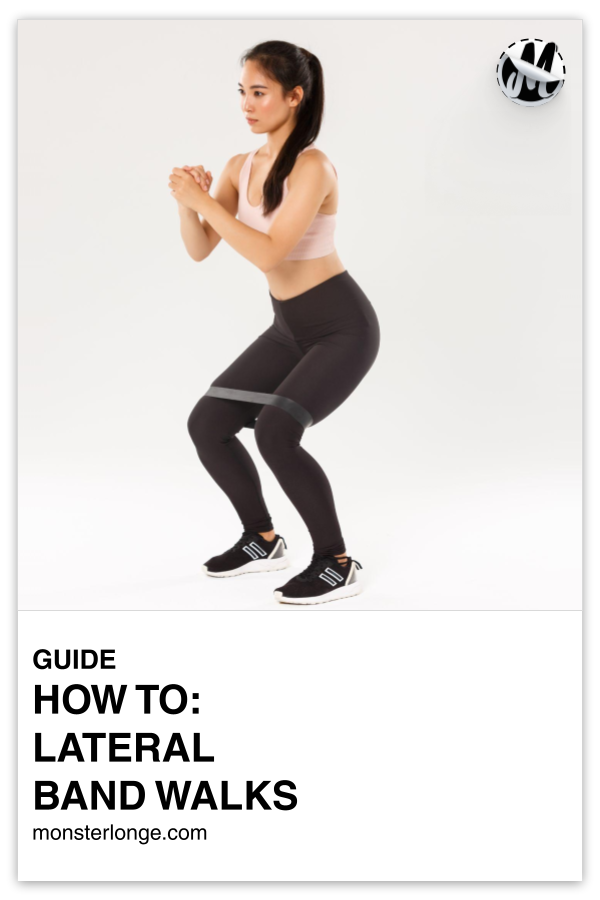
How To: Lateral Band Walks
Do you want a larger and shapelier backside?
If that’s the case, then you can’t go wrong with lateral band walks because the exercise specifically targets the gluteus medius and hip abductors, both of which contribute to giving the butt a fuller and rounder appearance when they’re developed.1The hip abductors include the gluteus medius, gluteus minimus, and tensor fasciae latae (TFL).2In addition to the gluteus medius and surrounding hip muscles, the lateral band walk also engages the hamstrings, quads, and gluteus maximus to a certain extent. Also, because the movement is performed standing up, the core is recruited as well.
As important as having a dump truck booty is, however, that isn’t the only reason to train the glute medius and hip abductors.
Nope!
The glute medius and hip abductors have several functions but apart from helping to move the leg away from the midline of the body, they’re also primarily responsible for keeping the pelvis steady. Well, because those muscles provide stability to the structure that transfers weight from the upper body to the lower body during movement, strengthening them can improve balance and reduce the risk of knee and hip issues, IT band syndrome, and lower back pain from those areas having to compensate. Also, by having stronger medial glutes and hip abductors to keep the pelvis properly aligned, you’ll be able to generate more power and move more efficiently, which can have the effect of helping to improve performance when running, jumping, squatting, deadlifting, and engaging in other activities.
INSTRUCTIONS
1). Stand with your feet hip-width apart and a band above your knees.3NOTE: The band doesn’t have to be around your knees. You can also place it further up your thighs or around your ankles or forefeet. Just keep in mind that the location of the band is correlated with the difficulty of the exercise and amount of glute activation that’s elicited. So if you want to make the exercise easier, then place the band around the thighs closer to the lever, which are the hips. The only drawback is that it won’t be as effective for the target muscles. If you want to perform the exercise with the most engagement of the glutes and without involvement of the tensor fascia latae (TFL), then place the band the furthest away from the hips, which is around your feet. The potential drawback with that placement is the increased challenge of performing the exercise. Having the band around the knees is the happy medium between what the other locations provide.
2). Press your hips back, bend your knees to lower into a quarter squat, and push your knees against the band to create tension so it’s taut.
3). While maintaining the quarter-squat position and holding your hands on your hips or clasped with your elbows bent in front of your body, brace your core, shift your weight to the right leg, for example, and push through that heel as you move the left foot directly sideways to the left against the band.
4). Plant the left foot on the ground.
5). Still in the quarter-squat position, shift your weight onto your left leg and push through that heel as you move the right foot sideways toward the left and plant it on the ground about shoulder-width apart from the other foot.
6). Without rising up from the quarter-squat position, perform the same sequence for the desired number of reps or until you cover a predetermined distance.
NOTE (1): Don’t lift your feet high off the ground. That happening can lessen the engagement of the target muscles. Instead, shuffle your feet low to the ground in the desired direction.
NOTE (2): If your knees buckle toward the midline of your body as you go from side-to-side, then you either need to work on preventing your knees from collapsing or choose a lighter band because the resistance from the one you’re using is too heavy.
NOTE (3): Don’t take too wide of a step to the side, as that can lessen the activation of the glute medius and cause for the recruitment of other muscles to compensate. Instead, take relatively small steps to create the most tension.
NOTE (4): For extra resistance, if necessary, add another band to a separate location. For example, if you have a band around the knees, place a second band around the ankles or forefeet.

For a workout routine that possibly includes lateral band walks, as well as other exercises geared specifically to your goals, training experience, injury history, and available equipment, then find out more HERE
Glossary: deadlift, exercise, exercise equipment, glutes, goal, muscle, routine, squat, squats, training, workout

- Just The Tip #4441 - May 5, 2026
- Just The Tip #400 - May 4, 2026
- Just The Tip #3017 - April 30, 2026