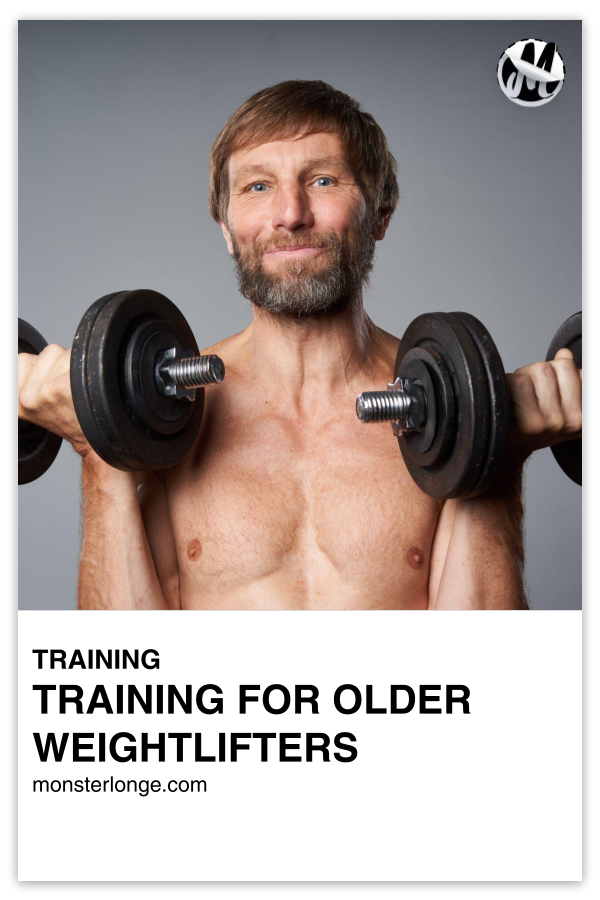
Training For Older Weightlifters
It’s come to my attention that I don’t do enough for old people.
I find that shocking considering my personal reverence for my elders and all they’ve done to ensure a better and brighter tomorrow for the generations behind them when it comes to the environment, economy, housing and labor market, national debt, and so forth. They truly are to be commended for the job well done!
*slow golf clap*
Anyway, with it in mind that I can be a bit more inclusive with some of my content, I thought it a good idea to cover the topic of training for older weightlifters like yourself. Admittedly, I and others certainly can’t repay people like you for all the great and wonderful things you’ve done to pass the country off in such good condition for Millennials and generations behind us, but I hope the following advice makes a dent in our indebtedness!

There’s no shortage of articles and blog posts that make it seem like the entire approach to weightlifting has to change once you reach 50 and beyond. The truth of the matter, however, is that with a few exceptions, virtually everything that you would do when you were younger is exactly what you should do as you get older.
One of the very few things that should change with your age is your primary goal. Rather than wanting to lift for the exclusive purpose of walking around jacked to overcompensate for a micropenis, for example, your reason to take up or continue weightlifting when you’re older should be more holistic, such as to build strength and improve mobility to make the present and future performance of everyday activities easier, like carrying groceries, getting in and out of chairs, and giving some child’s grandmother the business as she’s bent over in doggy during the nursing home’s weekly orgy when your children finally dump you in one.
With advanced age, the benefits to health and wellbeing should take precedence over the superficial reasons to lift. To reap those rewards, the same approach to building strength and muscle should be taken that everyone else much, much, much, much younger than you would take, which is to lift heavy weights and apply the concept of progressive overload. Challenging yourself and gradually increasing the amount of weight over time should be part of the training plan across all age groups and levels of experience. The only thing that should vary is the exercise selection and training volume and frequency. For example, shoulder impingement and rotator cuff tears are common in elderly individuals so overhead presses and behind-the-neck pulldowns can be poor choices of movements because of the increased risk of injury from the stress placed on the shoulder and rotator cuffs. Also, because the body’s ability to recover and heal slows down, the workload during a session should be less, which might involve only doing three sets for an exercise and going to failure more strategically and not as often, as well as allowing more rest days between working the same muscle groups.
Everything about lifting weights should remain the same irrespective of age, apart from a few things. As we’ve seen so far, what should be different is your main objective for lifting. That should differ from what it would be were you younger, as should the attention paid to the particular exercises you perform and impetus placed on the avoidance of overtraining. What else should change is the way you think about progress and results.
Someone of an advanced age who’s new to weightlifting should understand that they’re not going to build as much muscle or have the same strength levels as someone 100 years younger than them. Instead, they should temper their expectations because the body’s ability to make drastic improvements declines as you get older. As such, they should compare themselves only to those in their cohort. As for someone with experience, there’s no point comparing your current fitness against what it was in your 20s or 30s. Power, strength, and muscle wane as you age, so you’re not going to be capable of doing what you once could. Instead of dwelling on the past and getting discouraged, you should focus on the present and similarly compare yourself to those in your age group, many of whom you’re still stronger and in better shape than due to the time spent taking care of yourself while they didn’t.
Glossary: exercise, fitness, frequency, goal, muscle, muscle group, rest day, results, train
Monster Longe is a personal trainer and online coach in San Diego. He's helped hundreds of people lose weight, build muscle, and become more attractive to their loved one so they don't have as strong of a desire to cheat on them anymore. When not working with clients or making content that's easy to read, understand, and apply to everyday life, he enjoys making fun of Drake and people who like the guy.
Latest posts by Monster Longe
(see all)